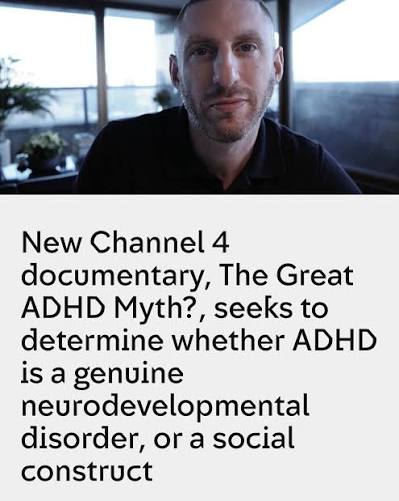
Channel 4’s The Great ADHD Myth? Why It Is Concerning
ADHD Is Not a Myth: Why Channel 4’s New Programme Is Already Causing So Much Concern
I honestly couldn’t believe it when I saw that Channel 4 is airing a programme called The Great ADHD Myth?
The programme sets out to question whether ADHD is a genuine neurodevelopmental condition or a “social construct”. Its promotional material asks whether phones, ultra-processed food and the education system could be responsible for ADHD traits, while using language such as “mind-altering drugs” and “medicating a generation of children”.
The programme hasn’t aired yet, so this isn’t a review of something I haven’t watched. My concern is about the title and the way Channel 4 has already chosen to present it.
Because the idea that ADHD may be a “myth” isn’t a harmless or balanced starting point.
ADHD did not begin with social media
ADHD is not a social media trend. It is not caused by a bad diet, poor parenting, a lack of discipline or too much screen time.
It is a recognised neurodevelopmental condition with a strong genetic basis, and it often runs in families. It didn’t suddenly appear with smartphones, TikTok or changes in the way children are being raised.
The difference now is that we understand far more about ADHD than we used to.
More people are talking about it. Adults who were overlooked as children are recognising themselves. Women who spent decades being diagnosed with anxiety or depression, or simply being told they were disorganised, oversensitive or not trying hard enough, are finally beginning to understand why they have struggled.
An increase in referrals does not prove that ADHD has suddenly been invented or that people are being handed diagnoses without proper assessment. Channel 4’s own announcement refers to an increase in referrals - not evidence that ADHD itself has become more common.
Research also continues to show that ADHD remains greatly under-recognised in adults. A recent UK study found that only a small proportion of adults likely to have ADHD had actually received a diagnosis.
Why this feels personal to me
I was diagnosed with ADHD 14 years ago, at the age of 38.
My diagnosis didn’t suddenly give me ADHD. It gave me an explanation for all the difficulties and challenges I had experienced throughout my life.
I now work with women who have often spent most of their lives blaming themselves for things they never understood. Many have pushed themselves harder and harder, trying to function in ways that simply weren’t working for them, until they reached burnout.
For many women, diagnosis brings relief, grief and sometimes anger about how long they have struggled without knowing why. But it can also be the beginning of understanding themselves, finding the right support and learning to work with their ADHD rather than constantly fighting against it.
That is why the suggestion that ADHD itself might not be real feels so deeply insulting to those of us living with the condition.
Us living with ADHD have already spent far too much of our lives being doubted, dismissed and told we simply need to try harder. We certainly don’t need a national broadcaster giving more credibility to those beliefs.
There are important questions that should be asked
Of course we should be able to have honest conversations about ADHD.
We should be talking about the enormous waiting lists for assessments, why so many women and girls are still missed, the lack of support after diagnosis and why ADHD services remain so under-resourced.
We should be able to discuss how ADHD is assessed and the different treatment options available. Medication isn’t right for everyone, and nobody should be pressured into taking it.
But that is completely different from giving airtime to the idea that ADHD itself may be a myth.
Channel 4’s announcement describes an experiment involving one child, replacing prescribed medication with activities such as exercise, more time outside, creative activities, reduced screen time and changes to his diet, to see whether he can come off medication altogether.
Those things can all be helpful forms of support. But helping someone manage their ADHD does not prove that the ADHD has disappeared -or that it was never there in the first place.
As ADHD UK says in its open letter, sport can support someone with ADHD, but it does not switch the condition off. The charity has also raised serious questions about the medical and ethical oversight of using one child’s experience in this way.
One child’s experience cannot tell us whether ADHD is real, whether medication works or what is right for millions of other children and adults.
This is not just a television debate
The way ADHD is being portrayed has consequences.
It affects whether parents believe their children. It affects how employers respond when someone asks for reasonable adjustments. It affects whether partners and family members understand that ADHD difficulties cannot simply be solved by trying harder.
It also affects the way people with ADHD see themselves.
ADHD UK has also raised serious concerns about the programme’s title and promotional framing, the involvement of a child in the experiment, and the apparent lack of an ADHD voice or mainstream ADHD specialist in Channel 4’s announcement.
The charity also reported that, following a previous television programme about ADHD, 90% of more than 2,200 people it surveyed felt the programme had increased stigma.
That matters.
An ADHD diagnosis can save lives
Receiving an ADHD diagnosis is not simply about being given a “label.”
It can give someone an explanation for years of difficulties they have blamed themselves for. It can open the door to appropriate treatment, workplace adjustments, practical support and a much better understanding of what they need.
The NHS recognises that people with ADHD are at increased risk of mental health difficulties and suicide. Recent UK research has also found a substantial life-expectancy gap among adults diagnosed with ADHD, highlighting the serious consequences of unmet needs and inadequate support.
This is why I say that receiving an ADHD diagnosis can -and does -save lives.
Not because a diagnosis magically fixes everything, but because understanding what is happening and receiving the right treatment and support can completely change the direction of someone’s life.
What Channel 4 should be investigating
There are so many important ADHD stories Channel 4 could be telling.
Why are families waiting months or years for an assessment?
Why are women still reaching their forties, fifties and beyond before being diagnosed?
Why is there so little support available after diagnosis?
Why do so many people reach burnout before their ADHD is recognised?
Why are people still being dismissed, judged and accused of following a trend when they ask for help?
These are the questions that urgently need attention.
ADHD is not a myth. The waiting lists are real. The lack of support is real. The stigma is real. And the impact on people’s lives is very real.
What you can do
I would encourage anyone who shares these concerns to read ADHD UK’s open letter and make a complaint directly to Channel 4 about the title and the way the programme is being promoted.
As the programme has not yet aired, Ofcom advises people to raise their concerns with the broadcaster first. Once it has been shown, anyone who believes the programme has breached broadcasting standards can then make a complaint to Ofcom.
This isn’t about preventing difficult conversations or attacking the people involved.
It is about asking Channel 4 to approach ADHD responsibly, listen to those who live with it and recognise the harm that can be caused when an established neurodevelopmental condition is presented to the public as a possible myth.
People with ADHD have fought hard enough to be believed.
We deserve far better than this.
Learn more about Kristina Stromberg and her approach to ADHD and AuDHD coaching.
